


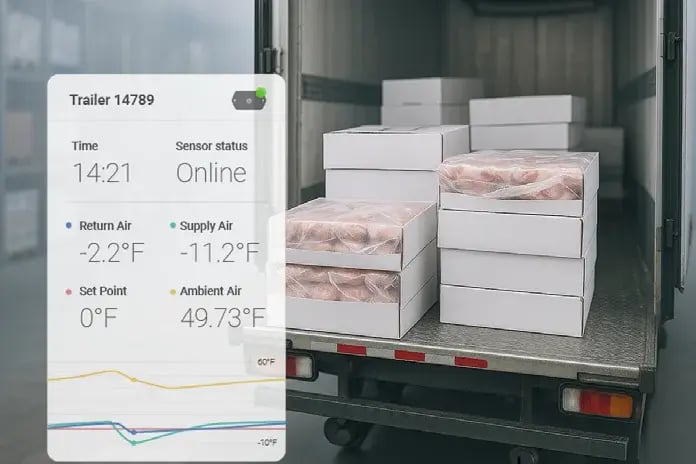
Alerts Your Team Can Trust
A major foodservice distributor in the U.S. trusts the EROAD Cold Chain Solution to ensure quality and compliance. Monitoring actual product temperatures provides a more accurate picture of what is happening with a load. The result: alerts slashed in half and an extra 90+ minutes to prevent a costly lost load compared to return air monitoring.
Return Air vs. CoreTemp
Data taken from a real-world route demonstrates how tracking actual product temperatures results in fewer alerts, while extending the mitigation window 90+ minutes, when compared to return air monitoring.
The Load
| Unit | Compartment | Set point | Product |
|---|---|---|---|
| Reefer trailer | Frozen zone | 0°F | Protein sandwich |
Three Ways of Measuring Risk
| Alert type | Method | Total alerts | Mitigation window |
|---|---|---|---|
| Delta | Return air | 1 | None defined |
| Multi-level | Return air | 6 | 2h 44m |
| CoreTemp | Product temperature | 3 | 4h 20m |